Mapy Debaty (Debate Maps) — AI-Powered Maps of Legislative Debate
Share project
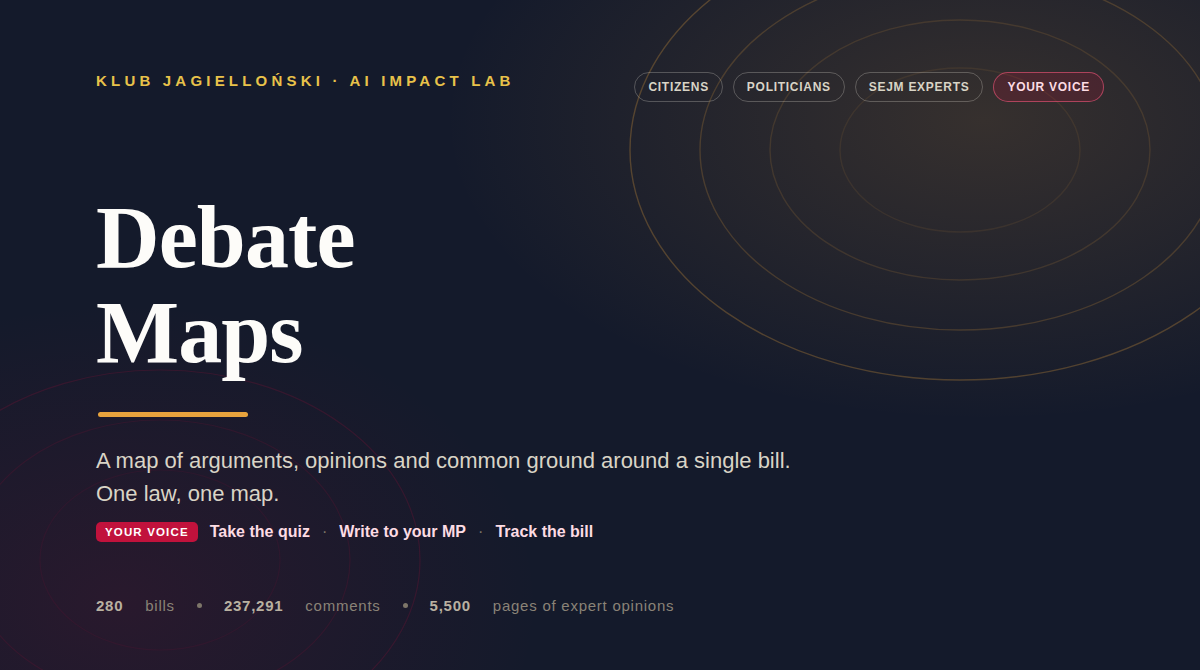
Table of contents
- The problem
- What's already in place
- Project scope
- Users and functionalities
- Data
- Desired expertise
- Success vision
- Supporting resources
The problem
Problem statement
Every bill in the Polish parliament (Sejm) generates hundreds of thousands of citizen consultation comments and thousands of pages of expert legal, economic and social opinions — much of it unstructured text or scanned PDFs that nobody systematically reads or cross-references. Public debate collapses into two shouting camps ('for' vs 'against'), while the real landscape of arguments — where citizens, politicians and the Sejm's own independent experts agree, merely need clarification, add new considerations, or flatly contradict each other — stays invisible. This recurs on every single bill, and it blocks scale directly: today, closing that gap for even one bill requires a small analytical team to manually read and categorize two dense source documents (the sponsors' own declared impact assessment and the Sejm's independent regulatory impact opinion). That manual approach cannot extend from a single pilot bill to the 280+ bills processed per term, nor to the hundreds of thousands of consultation comments already sitting unprocessed.
What's already in place
Current tech stack
- Web application
- Cloud infrastructure
- APIs or external integrations
- Frontend or user interface
- Backend or core logic
- Data pipelines or databases
- AI or analytics components
- Integrations with external systems
Three working prototypes exist: a consultation reader that ingests and structures citizen comments on a bill, an opinion summarizer that condenses expert legal/economic/social analyses into plain language, and a citizen segment where a reader forms their own position via a short quiz and sees concrete next steps. The linked prototype shows the core mechanism end to end on a real case — druk sejmowy nr 2144, a hunting-law amendment. An AI model ingests the two source documents (the sponsors' own impact declaration, DSR, and the Sejm expert bureau's independent regulatory impact opinion, OSR) and automatically classifies each of 8 substantive topic areas as convergent, needing clarification, an added consideration, or a genuine divergence, with every claim linked to its source page. On top sits a four-voice map (citizens, politicians, Sejm experts, 'your voice') plus citizen actions: a 6-question position quiz, a pre-drafted email to your MP, and legislative-status tracking. At pilot scale the underlying pipeline has already processed real Sejm data — 280 bills, 237,291 citizen comments and 5,500 pages of expert opinions — turning an unread mass of documents into a navigable, sourced map, and reducing what used to be manual analyst reading to an AI-first pass that a small team then verifies.
Project scope
Three concrete workstreams, mirroring our three technical priorities. (1) A public-facing service with a real interface: the same bill opens differently for a journalist (headline and number up front), a politician (where the three voices converge, diverge, or need clarification) and a citizen (form a position, see what to do next) — designed for a phone as much as a laptop. (2) An automated data-collection pipeline that pulls bill texts, citizen consultation comments, expert opinions and legislative-status updates from four separate sources into one human verification gate before anything reaches the map — that gate is the only step meant to stay manual. (3) Stable OCR and AI analysis for long Polish legal documents (multi-page opinions, footnotes, scanned stamps, poor scans) — testing multiple models for Polish-language legal comprehension, adding explicit accuracy controls, and keeping continuous human review, since every misread line is an argument that falls off the map.
Users and functionalities
Citizens: read the map for a bill that affects them, form a position through a short quiz, see who shares their view, send a pre-drafted email to their MP, and follow the bill's progress. Journalists and policymakers: get the headline and the key figure immediately, then drill into where politicians' claims, Sejm experts and citizen consultation responses converge or clash, each point linked to its source page. Our own analytical team: review and verify the AI's categorisation and OCR output before anything is published — the one step that stays human by design.
Data
Data Readiness
- Internal databases or systems
- Public or open datasets
Desired expertise
Tech partner role
NLP/LLM engineers with strong Polish-language experience for legal-text classification; OCR specialists for long, messy legal PDFs (multi-page opinions, footnotes, scanned stamps); data engineers to build the automated four-source ingestion pipeline; full-stack developers for the public-facing service; and a UX/product designer able to shape distinct, mobile-friendly entry views for journalists, politicians and citizens.
Success vision
If this problem were solved, any citizen, journalist or policymaker could open a single 'debate map' for a given bill and immediately see, topic by topic, where the politicians' declared impact and the experts' independent assessment converge, merely need clarification, add new considerations, or genuinely diverge — every claim linked back to its source page, with citizen consultation input folded in as a third voice. Success looks like: less polarization, because people see the actual map of arguments instead of two competing narratives; citizens who can act immediately on what they read (contact their MP, follow the bill's progress); and a categorization step that today needs a dedicated analyst team per bill being done first by AI and only verified by humans — so the process scales across the full legislative docket instead of one bill at a time.

Klub Jagielloński
Klub Jagielloński is an independent civic organisation committed to building cross-partisan consensus around the most pressing challenges facing Poland and Central Europe. We believe that durable solutions to public problems require depoliticisation, grounding policy dialogue in evidence, expertise, and shared values rather than partisan interest. Our work is guided by a vision of a future in which the dignity of every person stands at the centre of public life, institutions, and economic systems. Through analysis, education, and dialogue, we bring together people of different backgrounds and convictions to find common ground in service of the common good.
Website
.png&w=3840&q=75)