
Share project
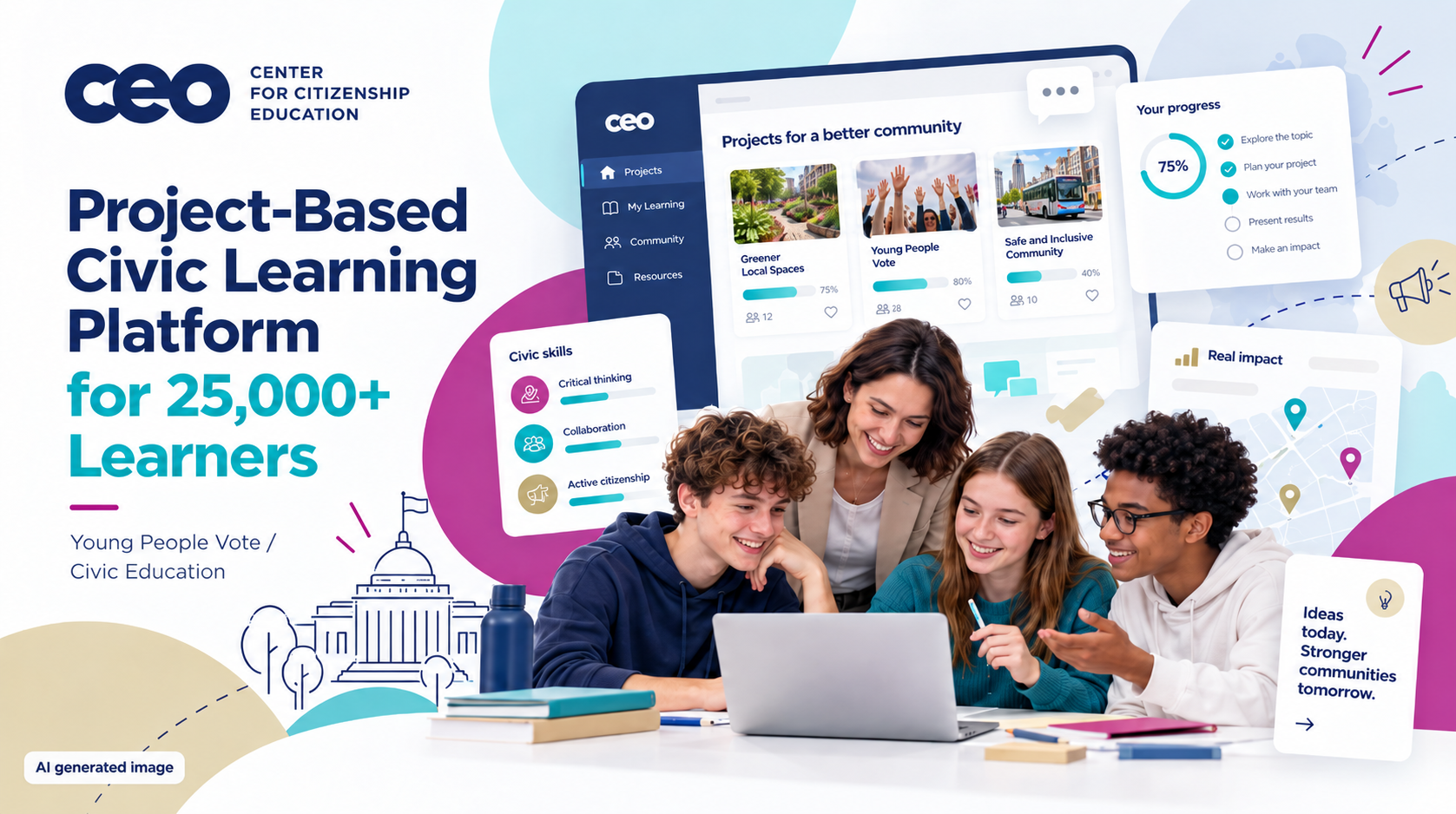
Table of contents
- The problem
- What's already in place
- Project scope
- Users and functionalities
- Data
- Desired expertise
- Success vision
- Supporting resources
The problem
Problem statement
CEO is seeking a technology partner to build a new digital platform for practical civic and electoral education.
The project addresses three connected gaps. First, a practice gap: civic education in Poland is still often theoretical, while students need to develop civic competences through action. Second, a support gap: teachers implementing project-based learning must often coordinate several groups, preserve student autonomy, monitor progress, give feedback and assess the process without adequate digital support. In a SOS dla Edukacji survey on the new Civic Education subject, 33% of teachers had not received related professional development; 80% indicated a need for ready-to-use materials, 48% for workshops/training and 42% for NGO support. CEO’s research with SWPS University similarly showed a need to make civic learning more practical and relevant. The introduction of compulsory Civic Education in 2025, including a project component, makes this especially urgent.
Third, a delivery gap: in CEO we have a proven project-based methodology, but lacks scalable infrastructure to implement it consistently nationwide. Our legacy Young People Vote platform was designed for periodic election campaigns and is now too rigid for year-round, multi-programme use. It lacks flexible workflows, effective student access, integrated feedback/reporting and real-time coordinator visibility. Work remains fragmented across email, spreadsheets and PDFs. We need a platform that turns CEO’s methodology into a repeatable, accessible digital process that can scale across schools and programmes.
AI will be a small, separate element only: the platform will link to our existing MEWA tool, which answers questions about election procedures, elected bodies and their competences, and it will host lesson scenarios on responsible classroom use of AI. The partner will not be expected to build, retrain or extend an AI model.
What's already in place
Current tech stack
- Web application
- Cloud infrastructure
- APIs or external integrations
- Integrations with external systems
- None / very early stage
Current/legacy platform: https://mg2025.ceo.org.pl/
We are seeking to build a new product from scratch, rather than scale the existing platform. However, CEO already operates a legacy digital platform supporting “Young People Vote” ("Młodzi głosują"), our nationwide electoral education programme. The platform is used during election cycles to support schools in organising mock elections, provide educational materials and project guidance, and collect and publish school election results.
Its scale demonstrates both strong demand and CEO’s ability to operate a nationwide digital programme. In the 2025 presidential election edition alone, nearly 700 schools participated and close to 200,000 students had the opportunity to take part in school mock elections. The programme enables young people to experience democratic procedures in practice: student teams organise elections, conduct turnout campaigns and discussions, while teachers receive scenarios, guides, webinars and other support.
The current platform was designed primarily around periodic election campaigns and now serves as a valuable functional reference rather than a technological foundation for the new solution. It does not support the year-round, multi-programme, project-based model we now need: flexible project workflows, student-group progress tracking, structured teacher/coordinator feedback, dashboards, integrated reporting and reusable programme templates. The new platform should therefore preserve what we have learned from operating Young People Vote at scale while replacing its technological limitations with a flexible solution designed for Young People Vote, Civic Education and future CEO programmes.
Project scope
We need an end-to-end technology partner to take the platform from a refined concept to production: product discovery and specification, UX/UI, front-end and back-end development, integrations, QA, accessibility and user-acceptance testing, deployment, documentation, training and handover.
Core build: responsive public and logged-in areas; role-based authentication/permissions; teacher and student-group areas; coordinator/admin dashboard; configurable project-workflow engine; programme modules with tasks, checklists, materials, text inputs and uploads; progress/status tracking; teacher/coordinator feedback and approvals; calendars, deadlines and notifications; public gallery; reporting and exports. Young People Vote also requires collection of school mock-election results and automated school-level/national aggregates. The platform should handle at least 5,000 users/day.
Integrations: two-way connection with CEO’s registration/enrolment system via our existing API, pulling teacher/school data and returning project-completion data for evaluation/certificates; structured links to CEO’s materials library; simple links/navigation to MEWA, Latarnik Wyborczy and CEO websites. The final architecture should be recommended during discovery. CEO is WordPress-oriented and open to WordPress, headless/hybrid WordPress or another maintainable solution.
Requirements include WCAG-oriented accessibility, GDPR/data minimisation (especially for minors), retention/deletion controls, audit logs, basic cybersecurity and deployment to CEO-controlled infrastructure. Handover must include source repositories, documentation and exclusive IP/source-code rights without future licence fees. CEO already has functional requirements, MVP/Nice-to-Have prioritisation, mapped user journeys, workflow/UI concepts and a legacy platform to inform discovery. The legacy platform is a reference and limitation case, not a codebase we want incrementally scaled.
Users and functionalities
-
Unauthenticated visitors: access public programme information, selected materials/scenarios, news, two educational games and links to CEO civic tools.
-
Teachers: accounts connected to programme registration; access the relevant programme area; create/manage student-group access; use project guides, materials and a short project-method course; set deadlines; monitor progress and activity; review modules, files and photos; provide feedback and approve work; publish selected projects; complete evaluation/reporting and download reports. In Young People Vote they also enter school mock-election results, including votes, valid/invalid ballots and turnout.
-
Student groups: log into a shared group account or another privacy-preserving model agreed during discovery; complete modules through forms/checklists; add text, files/photos; track progress; receive deadlines, notifications and feedback; browse selected projects from other schools; and download a group report. The aim is to support autonomy, collaboration, planning and learning through action rather than rote knowledge.
-
CEO programme coordinators: configure programmes, modules, content and materials; monitor schools, teachers and groups; identify inactivity; review progress; provide feedback; moderate/publish selected work; deploy evaluation forms; generate aggregate reports and exports. Dashboards should support relevant segmentation, e.g. by school type or voivodeship.
-
Platform administrators: manage users, roles, permissions, integrations, security and data-retention settings.
Young People Vote and Civic Education need different workflows but should reuse the same core architecture. The platform must be accessible for users with special educational needs and low vision and minimise personal data. AI is outside the core workflow: users may follow a link to the existing Mewa tool, while teachers can access scenarios about responsible classroom use of AI.
Data
Data Readiness
- Internal databases or systems
- Spreadsheets or documents
- Third-party systems
Desired expertise
Tech partner role
We need a partner with end-to-end product and web-platform capability rather than an AI-development team. Key expertise: discovery and technical specification for a multi-role, multi-programme service; information architecture and accessible UX/UI for teachers and young users, including low-vision users and special educational needs; front-end/back-end development with maintainable CMS/admin tools; role-based authentication and permissions; API/system integration, especially account provisioning and two-way data exchange with CEO’s registration system; configurable workflow engines, dashboards, activity monitoring, feedback/approval, reporting and exports; privacy-preserving data/account design for minors; GDPR-oriented data minimisation, retention/deletion, auditability and security; performance/scalability for at least 5,000 users/day; QA, accessibility testing, deployment and user-acceptance testing.
CEO already has a defined MVP/Nice-to-Have feature set, mapped user journeys for the main roles, preliminary workflow/UI concepts and a legacy platform as a reference. The partner should turn these inputs into wireframes, production-ready UI/UX and a maintainable technical specification.
CEO has a dedicated internal Internet Tools/IT team, its own domains and infrastructure for cloud-hosted solutions. We need pragmatic architectural advice and a solution our team can operate after handover. WordPress aligns with our current ecosystem, but headless/hybrid WordPress or another architecture is acceptable if it better meets performance and maintainability needs. The partner should provide documentation, training, deployment to CEO infrastructure, source repositories and transfer of exclusive IP/source-code rights without future licensing fees.
AI expertise is not required for the core build.
Success vision
Success means replacing fragmented processes with one accessible platform for practical civic learning year-round across CEO programmes.
External outcomes: teachers receive a ready-made project-based learning workflow instead of inventing their own processes. They can guide several student groups, set deadlines, monitor progress, review work, provide feedback and generate reports. The value for teachers is less administration, more time for students and greater confidence that projects are progressing as intended. Students receive a step-by-step project path, checklists, materials, deadlines, progress indicators and feedback while retaining responsibility for decisions. The value for students is greater clarity, stronger ownership and a visible sense of progress.
By the end of 2027, CEO aims to promote the platform in 2,000+ schools, train at least 1,000 teachers and engage 25,000 direct and up to 100,000 indirect beneficiaries.
Internal outcomes: CEO coordinators gain real-time visibility into participation, inactivity and project completion instead of collecting data manually. They can configure modules, provide feedback, deploy evaluation forms and export data for evaluation and reporting. The value for coordinators is faster access to reliable information, less manual coordination and greater control over programme quality at scale. A template-based architecture should let Young People Vote, Civic Education and future programmes use the same core roles, modules and reporting mechanisms.
Success also means a WCAG-oriented, GDPR-compliant solution able to handle at least 5,000 users/day and be maintained by CEO’s internal IT team after handover. It should integrate with CEO’s registration API, support privacy-preserving student/group access, and be delivered with documentation, training, source code and IP rights transferred to CEO. The value for CEO is reliable infrastructure for delivering its methodology consistently at national scale.
Supporting resources

Centrum Edukacji Obywatelskiej (The Center for Citizenship Education)
Our mission is to inspire school communities to adopt innovative teaching methods and introduce significant social issues to their work with students. Every year, we engage with 40,000 teachers and school principals from 10,000 schools across the country. We aspire for mutual respect and partnership to serve as schools’ foundational principles, and for adults to design teaching process in recognition and appreciation of young people’s natural desire to learn. Through our programs, we help schools become a place of shared learning, illustrating the power of civic participation and solidarity. We support schools in adopting practices that help young people find their life purpose, develop their passions, openness, and a sense of responsibility for the world we live in. Our areas of work include: - civic, voter and political education, - cultural education, - equality and inclusion education, - climate and global education. Our voter and civic education activities go beyond schools and reach out to adults as well, an example of which is Latarnik Wyborczy (the Electoral Lighthouse), Poland's most popular voting advice application (5.5 milion users in 2023) enabling people to easily compare their views with the declarations of political parties.
WebsiteExplore similar Projects
See all Projects
Sparky AI : delivering universal access to gamified & personalized education for learners worldwide
Unlock the future of education with Sparky AI, where personalized learning pathways empower every student to thrive, regardless of their background.